Messier 46 - Open Cluster
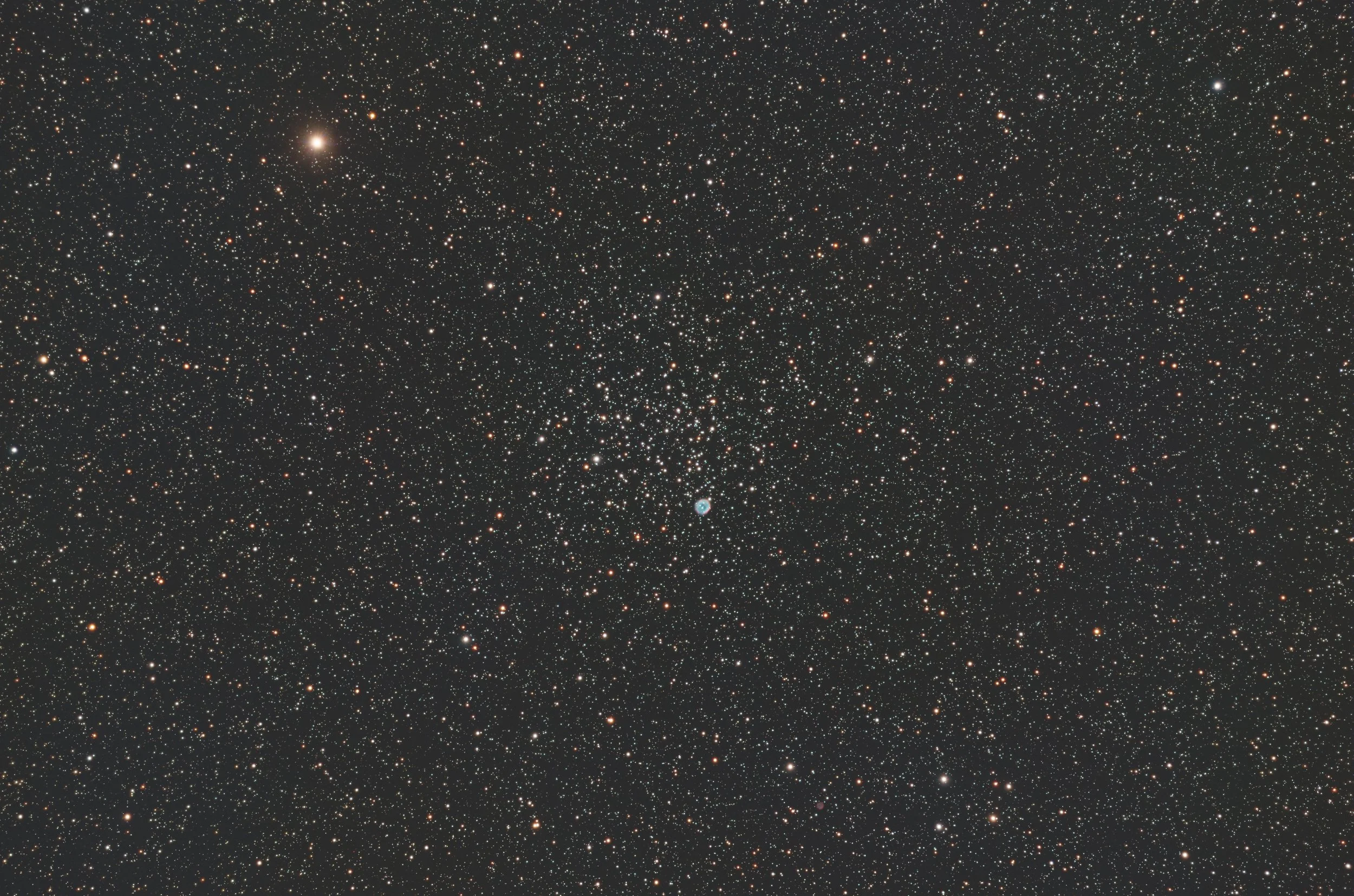
Messier 46 (M46), also catalogued as NGC 2437, was catalogued by Charles Messier in 1771. Messier described M46 as a cluster of very faint stars, mixed with some nebulosity; the stars are difficult to distinguish with an ordinary telescope.
Open Cluster
An open cluster refers to a group of stars that have formed in the same region, from the same molecular cloud, loosely bound by gravity. Stars that have formed in molecular clouds are mostly of a similar age and made up of similar compositions. These groups of stars generally contain anywhere from a few dozen to a few thousand stars that can be spread over a distance of up to 30 light-years, though this is considered irregular. Open clusters, on a galactic scale, are short-lived occurrences due to gravitational interactions with other stars and tidal forces of the Milky Way. Generally speaking, open clusters last only for a few hundred million years. Messier 46 is estimated to be about 251 million years old.
This open cluster has around 500 stars. This cluster is roughly 25-30 light-years across and is estimated to be around 450 solar masses.
Location
Messier 46 is located in the constellation of Puppis. Messier 46 around 5,000 to 5,500 light years away from Earth. It covers an area just slightly less than a full moon, covering about 27 arcminutes in the sky.
In the Southern Hemisphere, it is best observed in March.
Annotated Image
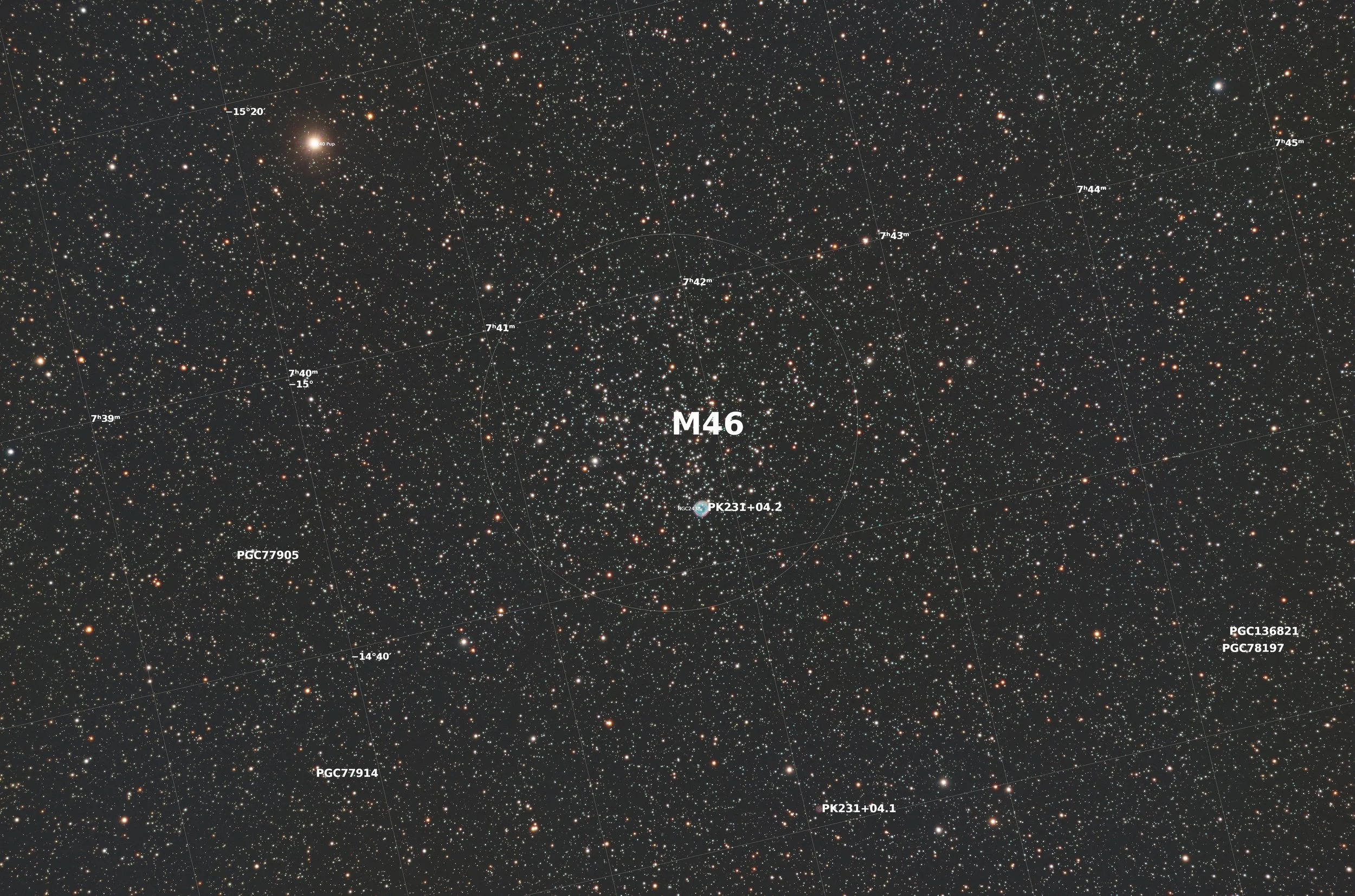
This image also contains two planatary nebuas. These have been identified as PK23I+04.2 and PK231+04.1. PK23I+04.2 has also been cataloyged as NGC 2438, this is a multi-shell planatary nebula located in front of Messier 46, about 2,000 to 3,000 light years away from Earth. There are also a number of galaxies marked in the image under the PGC (Principal Galaxies Catalouge).
Stars in Messier 46
Messier 46 is a rich open cluster, made up primarily of white and blue-white main-sequence stars, along with a scattering of evolved gaint stars. Main-sequence stars in M46 are similar in nature to our Sun in the sense that they are still actively fusing hydrogen into helium in their cores. However, many of M46’s main-sequence stars are more massive, hotter, and bluer than our Sun which is typical for a cluster of its age. There are also a number of evolved giant stars, which are more luminous and expanded compared to main-sequence stars.
Within M46, stars are also found in binary and multiple systems, where two or more stars are gravitationally bound and orbit a common centre of mass. These are fairly common in open clusters.
