Messier 20 - Trifid Nebula
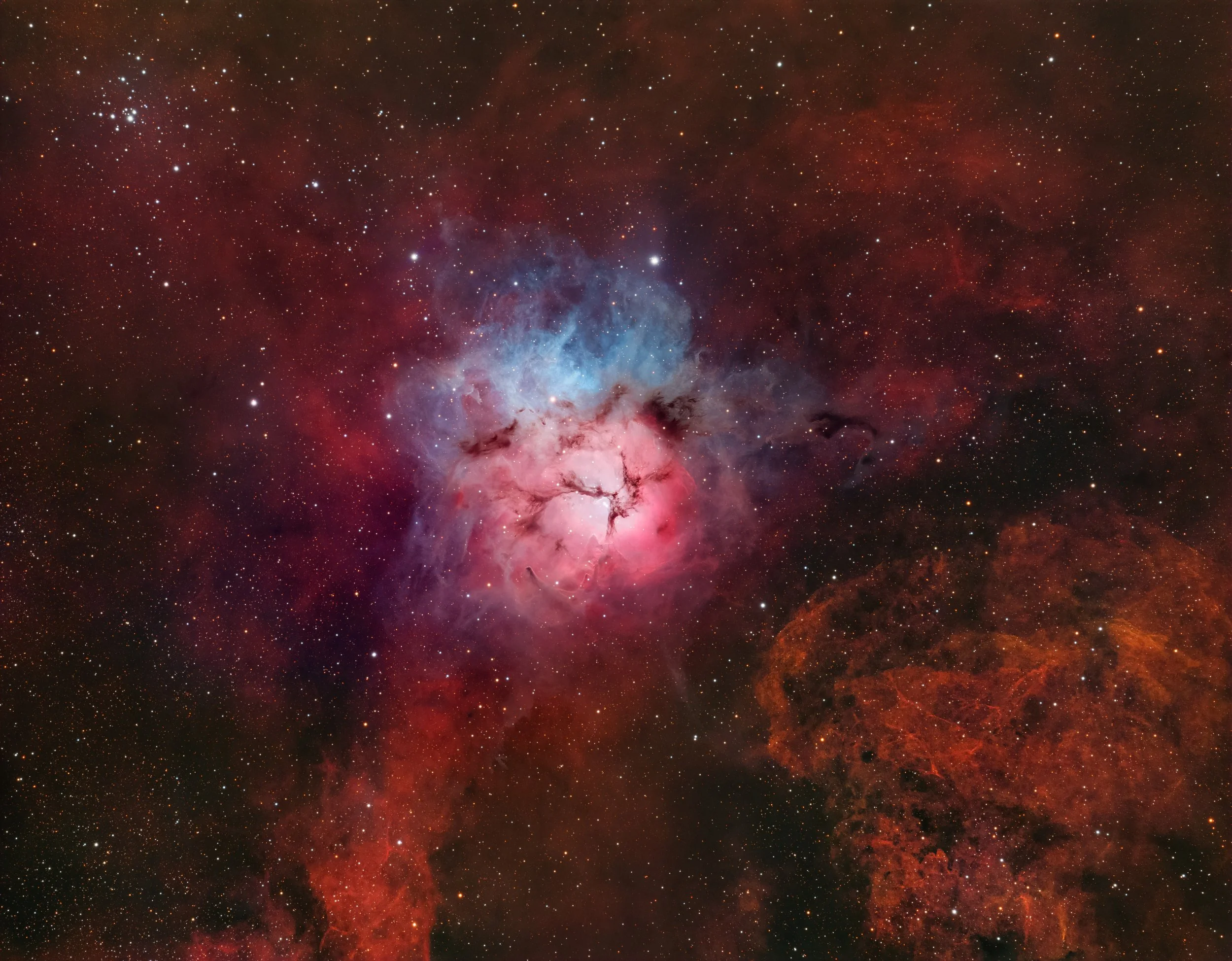
Messier 20 (M20), also known as the Trifid Nebula, was discovered by Charles Messier in June of 1764. It has also been categorised in the NGC catalouge as NGC 6514. M20 is unique because it contains a combination of nebula types, emission, reflection and dark.
Emssion Nebula
The red/pink region of Messier 20 is an emission nebula. Glowing clouds that are made mostly from hydrogen gas that is energised by intense ultraviolet radiation from nearby young, hot stars that are emitting distinctive red light, commonly seen in many star-forming nebulae. This is the brightest and most active part of Messier 20, where new stars continue to be born.
Reflection Nebula
The blue dusty regions surrounding the emission nebula form the reflection nebula. Unlike emission nebulae, these clouds do not produce their own light. Instead, fine dust particles scatter and reflect the light from the nearby stars, in a similar way to how Earth’s atmosphere scatters sunlight to create a blue sky. The reflected starlight gives this section of the nebula a soft blue appearance.
Dark Nebula
Thick lanes of dark dust, known as a dark nebula are also present in Messier 20. These dense clouds of cosmic dust block light from behind the nebula as well as stars, creating the dramatic dark bands that divide the emission section of Messier 20 into three sections. These dust lanes are why Messier 20 was called ‘Trifid’, meaning ‘divided into three parts. Inside some of these dark globules, new stars are likely forming. Astronomers have identified several evaporating gas globules, sometimes called “EGGs,” within the nebula.
Location
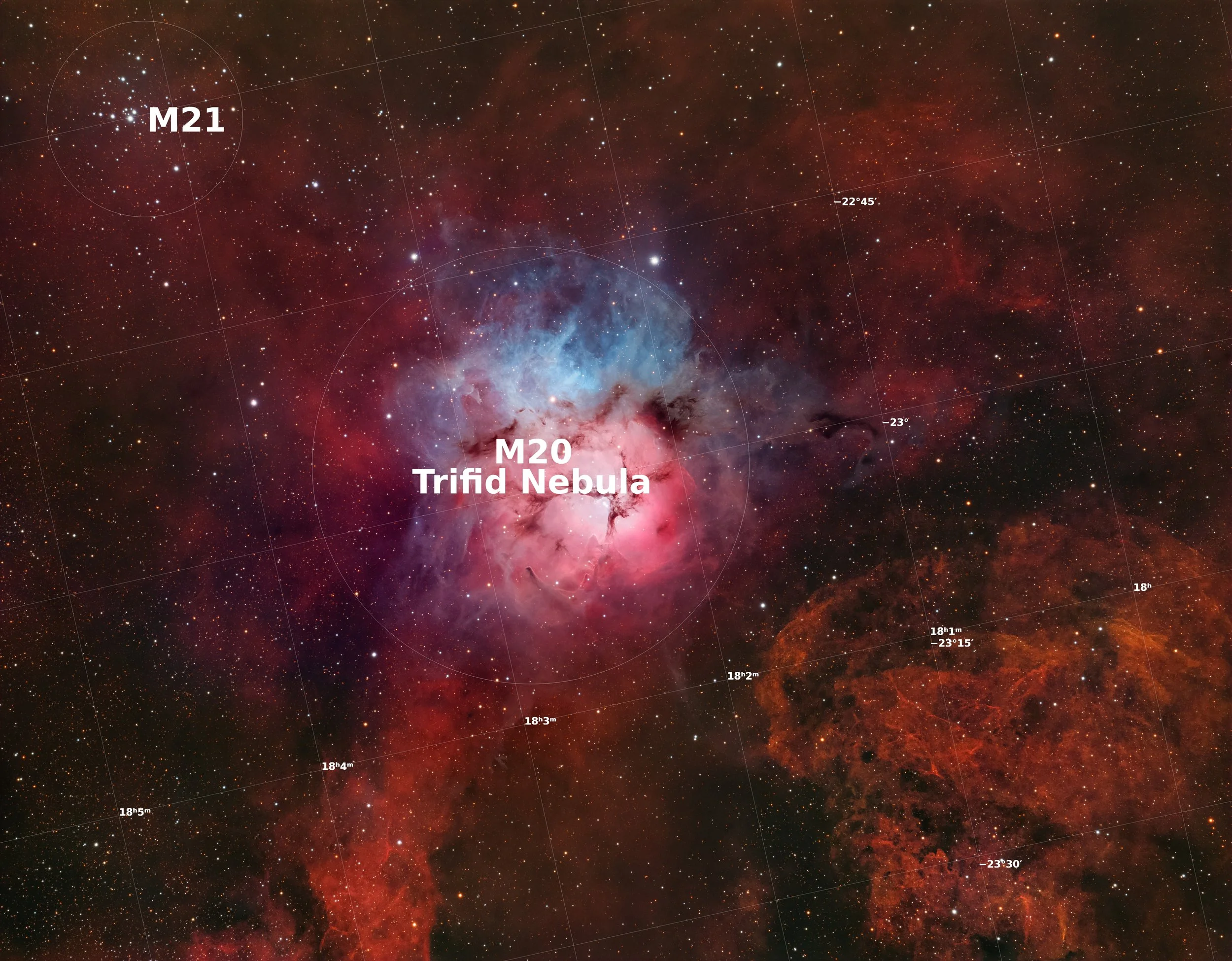
Messier 20 is located in the rich star fields of the constellation Sagittarius, close to the centre of the Milky Way. Wide field images of this region also show large surrounding hydrogen clouds and neighbouring deep-sky objects.
Annotated Image
Equipment
Telescope: ASKAR120 APO
Mount: HEQ5-Pro
Camera: ZWO ASI2600MM PRO
Filters: Antlia L, R G B, HA V-pro Series
Filter Wheel: ZWO EFW
Focuser: ZWO EAF
Computer: ZWO ASI AIR Pro
Guide Scope: ZWO 120MINI
Guide Camera: ZWO 120MM
Dew Heater: SV-BONY Dew Heater
Capture Details
Light Frames:
RED: 180 seconds x 55 frames
GREEN: 180 seconds x 55 frames
BLUE: 180 seconds x 55 frames
LUM: 180 seconds x 483 frames
HA: 180 seconds x 80 frames
Total: 36 hours
