Messier 86 - Elliptical/Lenticular Galaxy
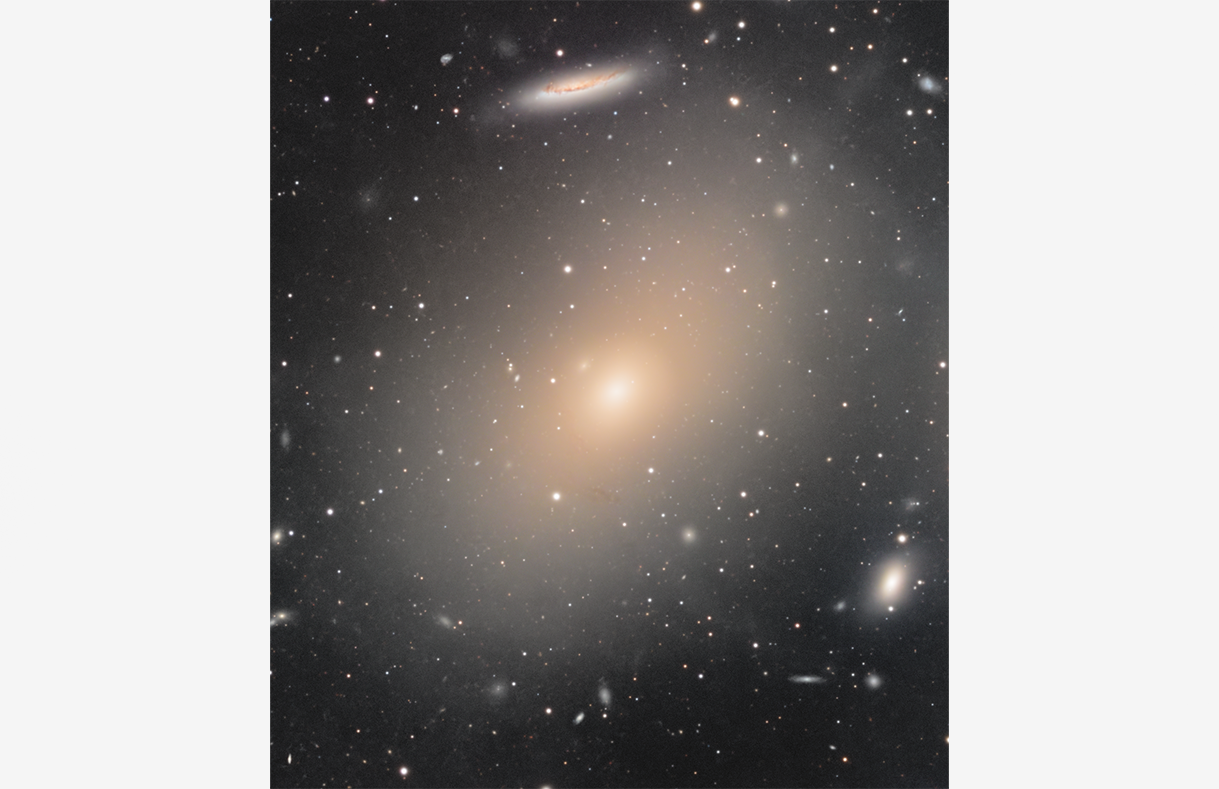
Messier 86 (M86) was discovered by Charles Messier on the 18th of March in 1781 (along with Messier 84) while he was surveying faint deep-sky objects in the constellation Virgo. This specific region is now commonly known as Markarian’s Chain. It is also catalogued as NGC 4406.
Elliptical Galaxy
An elliptical galaxy is a galaxy type that has a smooth, rounded appearance rather than the distinct spiral arms seen in other galaxies, such as Messier 66 (M66). The shape of this galaxy type ranges from spherical to stretched and slightly oval-shaped. Elliptical galaxies are home to mostly older stars, containing a very small number of young blue stars.
These galaxies are typically found in clusters of galaxies, and many astronomers believe that most elliptical galaxies likely formed from the collision and mergers of spiral galaxies. Likewise, Messier 86, it is believed to have formed through mergers with other galaxies over billions of years, likely disrupting any original spiral structures.
More specifically, M86 is listed as an Elliptical Galaxy (E3). Astronomers classify elliptical galaxies from E0 through to E7 based on how ‘structured’ they appear:
E0 = almost perfectly round
E1 = Slightly elongated
E2 = Mildy oval
E3 = Clearly ovel-shaped
E4 = Moderately elongated
E5 = Strongly elongated
E6 = Very elongated
E7 = Extremly elongated
This number is determined by a formula used based on the galaxy’s apparent shape:
Eₙ = 10(1 − b/a)
A = the length of the galaxy’s longest dimension
B = the length of the galaxy’s shortest dimension
Location
M86 is located 50 million light-years away from Earth, in the constellation Virgo and is a member of a large cluster of galaxies known as Markarian’s Chain. M86 is about 135,000-150,000 light-years in diameter, making it just slightly larger than the Milky Way (100,000-120,000 light-years). This galaxy has an apparent magnitude of approximately 8.9
In the Southern Hemisphere, this galaxy is best viewed in April.
If Elliptical, Why Structure?
One interesting thing about M86 is that, even though it is an elliptical galaxy, deep images of this object show faint dust lanes. This is typically seen as unusual because elliptical galaxies are generally lacking in gas and dust. The dust is thought to have been acquired through mergers, as mentioned previously.
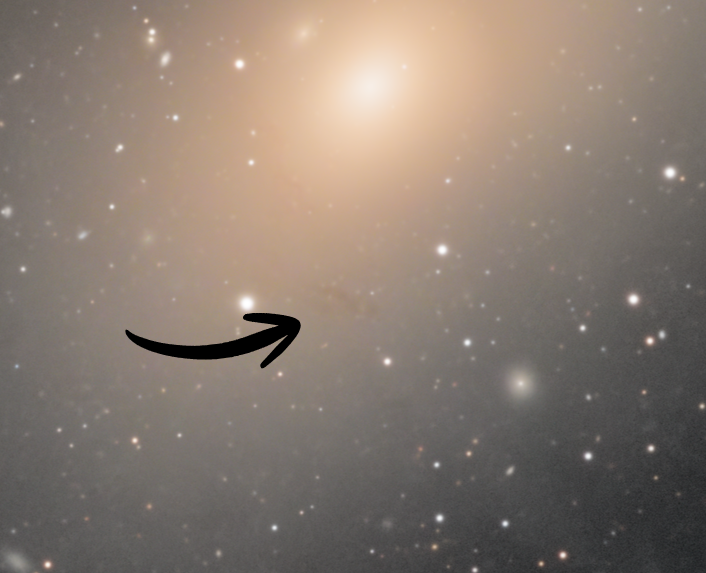
The arrow points to the dust lanes found in Messier 86.
The Fastest Galaxy in the Virgo Cluster
Messier 86 is considered special because while most galaxies in the universe are moving away from our Milky Way due to the expansion of the universe, M86 has a blueshift (light from this object is shifted towards the blue end of the spectrum, much like the redshift, which indicates an object is getting further away as the wavelength gets stretched), meaning it is getting closer to the Milky Way. It is estimated to be moving towards us at a speed of over 200km/s.
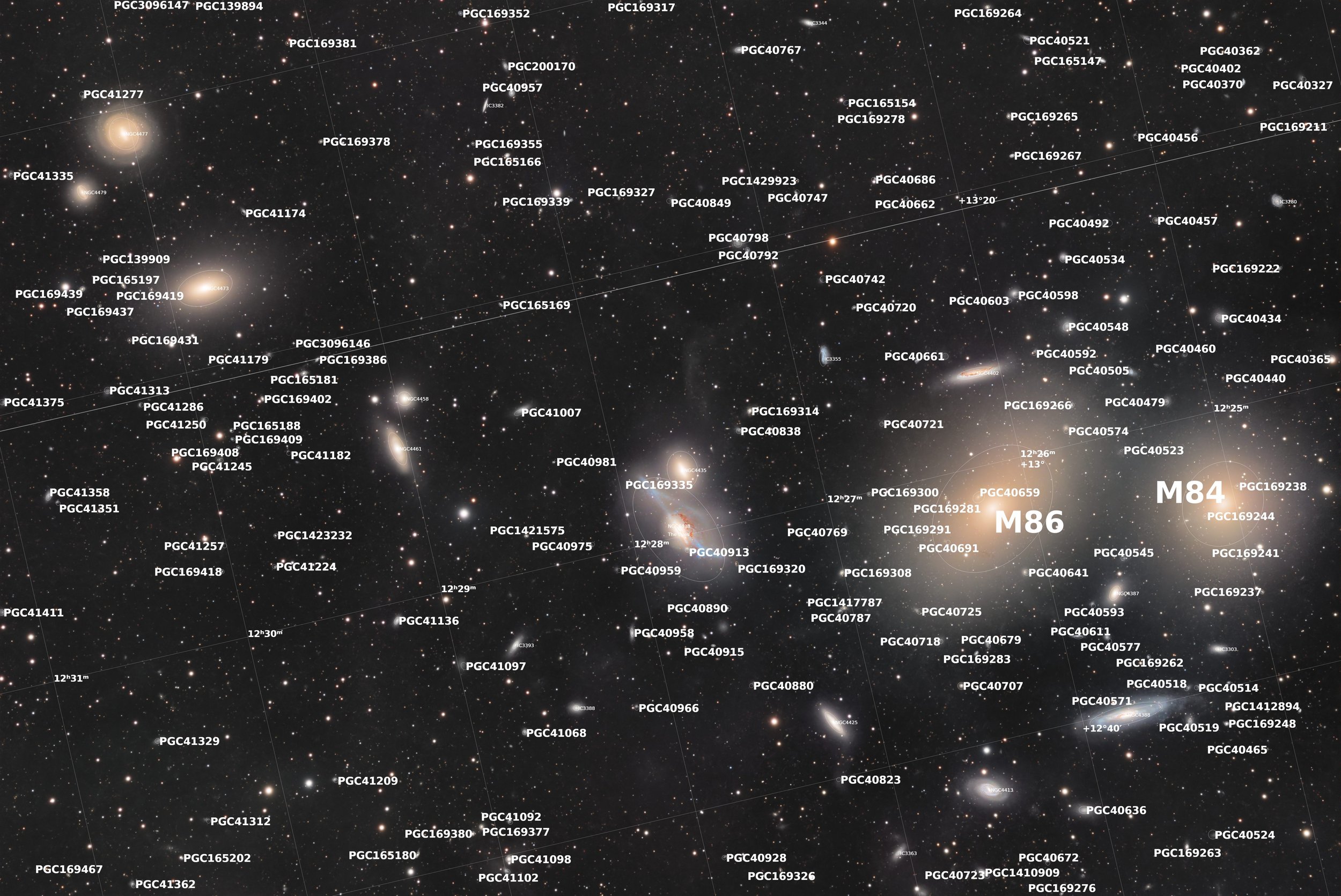
Full image of Markarian’s Chain
Equipment
Telescope: ASKAR120 APO
Mount: HEQ5-Pro
Camera: ZWO ASI2600MM PRO
Filters: Antlia L, R G B, HA V-pro Series
Filter Wheel: ZWO EFW
Focuser: ZWO EAF
Computer: ZWO ASI AIR Pro
Guide Scope: ZWO 120MINI
Guide Camera: ZWO 120MM
Dew Heater: SV-BONY Dew Heater
Capture Details
Light Frames:
RED: 180 seconds x 200 frames
GREEN: 180 seconds x 200 frames
BLUE: 180 seconds x 200 frames
LUM: 180 seconds x 733 frames
Total: 66.65 hours
