Messier 6 - Butterfly Open Cluster
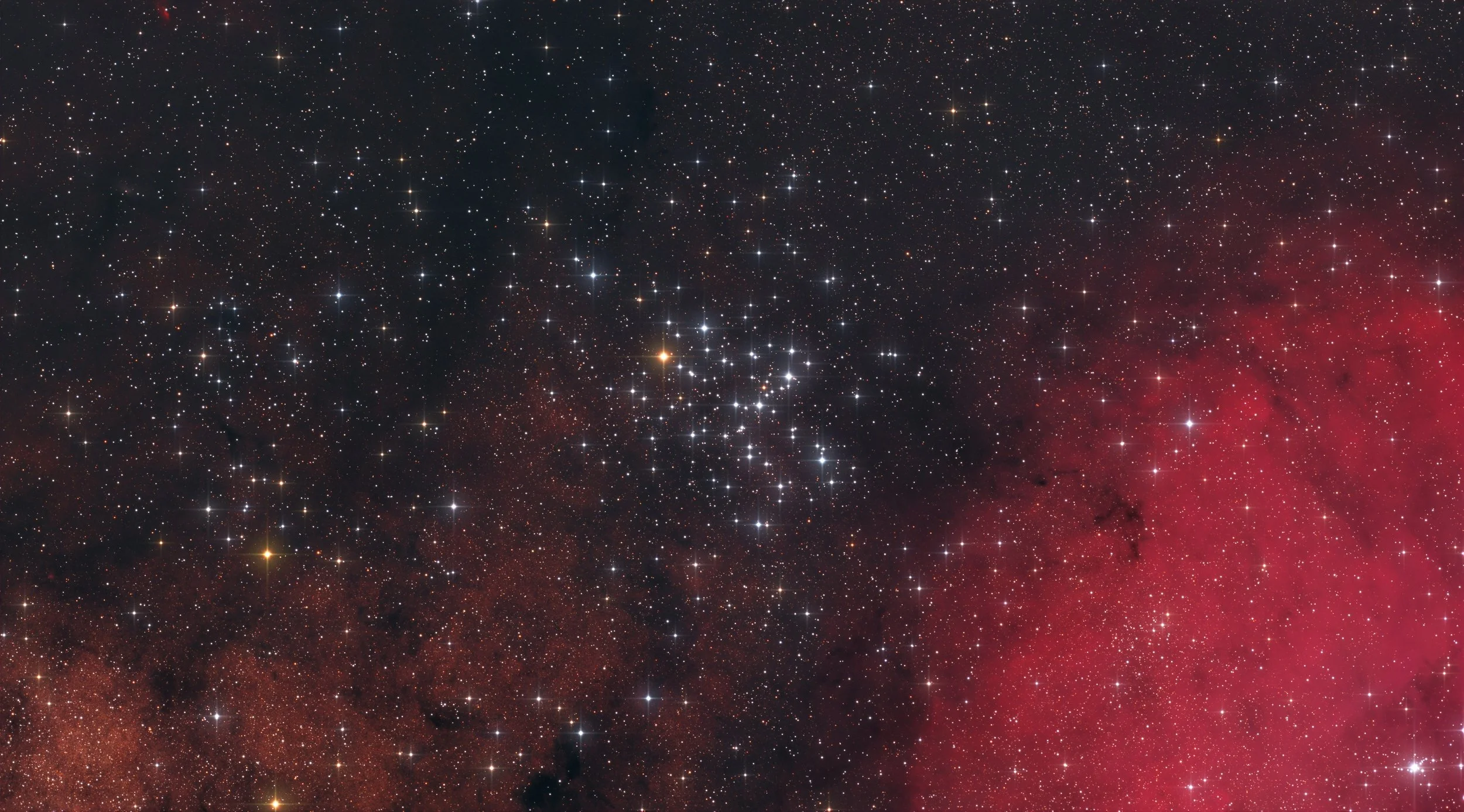
Messier 6 (M6), also known as The Butterfly Cluster, was believed to have been first recorded by Giovanni Battista Hodierna in 1654 before Charles Messier added it to his catalogue in 1764. M6 is an open cluster located in Scorpius.
Open Cluster
An open cluster refers to a group of stars that have formed in the same region, from the same molecular cloud, loosely bound by gravity. Stars that have formed in molecular clouds are mostly of a similar age and made up of similar compositions. These groups of stars generally contain anywhere from a few dozen to a few thousand stars that can be spread over a distance of up to 30 light-years, though this is considered irregular. Open clusters, on a galactic scale, are short-lived occurrences due to gravitational interactions with other stars and tidal forces of the Milky Way. Generally speaking, open clusters last only for a few hundred million years. Messier 6 is estimated to be about 94-100 million years old.
There are about 80-100 bright stars that form the prominent shape of the cluster, with a total number of stars estimated to be 100-120.
Location
Messier 6 is located in the constellation of Scorpius. It has been measured to be around 1,600 light-years away from Earth and 12-25 light-years across.
In the Southern Hemisphere, it is best observed in July.
Annotated Image
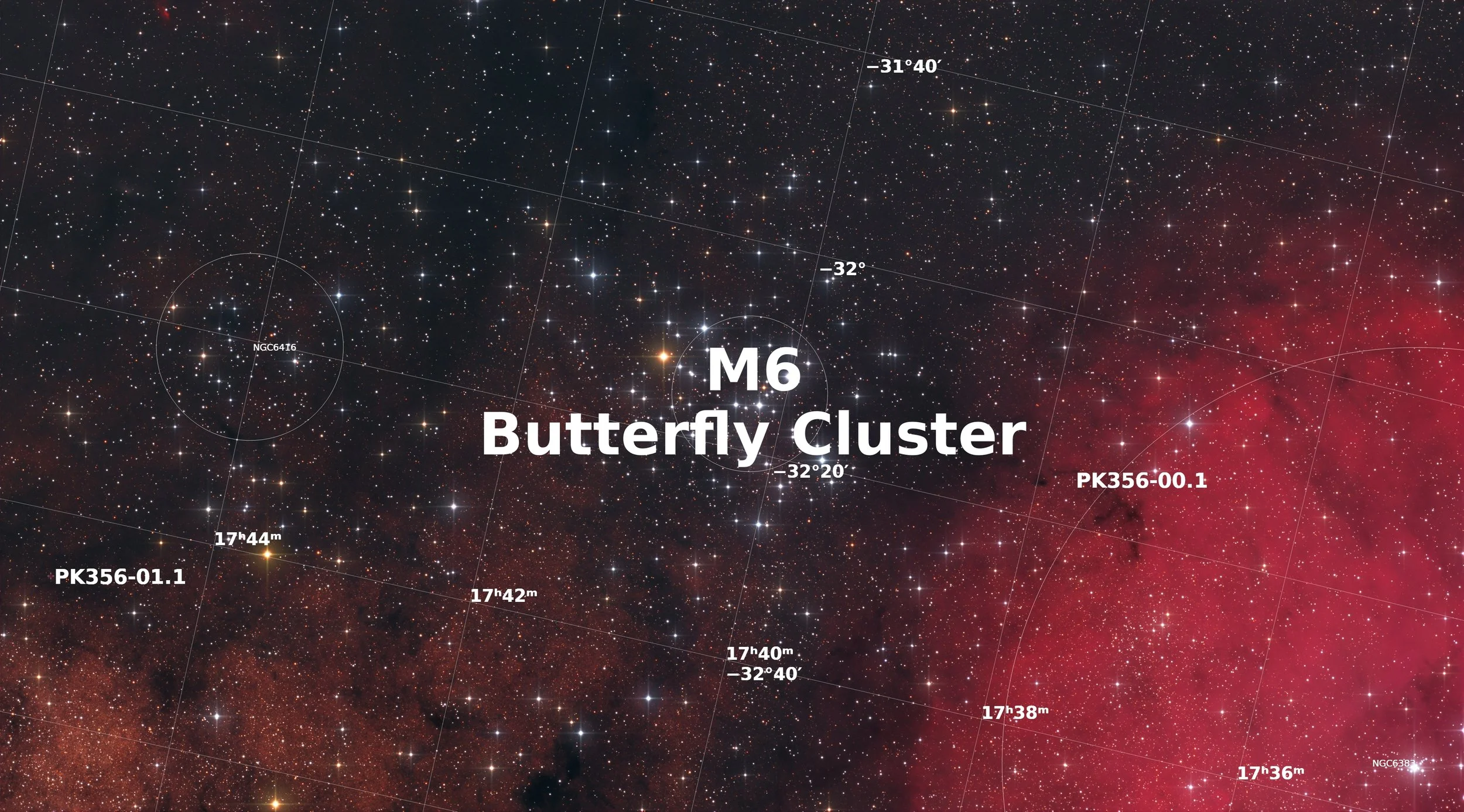
This image caintains another open cluster known as NGC 6416, which is about 2,400 light-years away from Earth. Another young open cluster is also annotated at the bottom right of this image, being NGC 6383, about 3,500 light-years away. There are also two background galaxies identified, being PK356-01.1 and PK356-00.1.
Stars in Messier 44
Messier 6 contains mostly hot, young blue main-sequence stars, along with a number of prominent cool orange-red giant or supergiant stars.
Main-sequence stars are like our very own sun; they’re still fusing hydrogen in their cores. As for the red giants, these are brighter, more evolved stars that have left the main-sequence phase and have turned into red giants. Typically, they are cooler than our sun but more luminous. White dwarfs are stars that have completed their life cycle. They are what remains of the star, a hot, dense core. All that remains of a low-to-medium mass star has exhausted its fuel. There are also several binary or even triple systems, stars with one or more companions.
Lets Test the Science
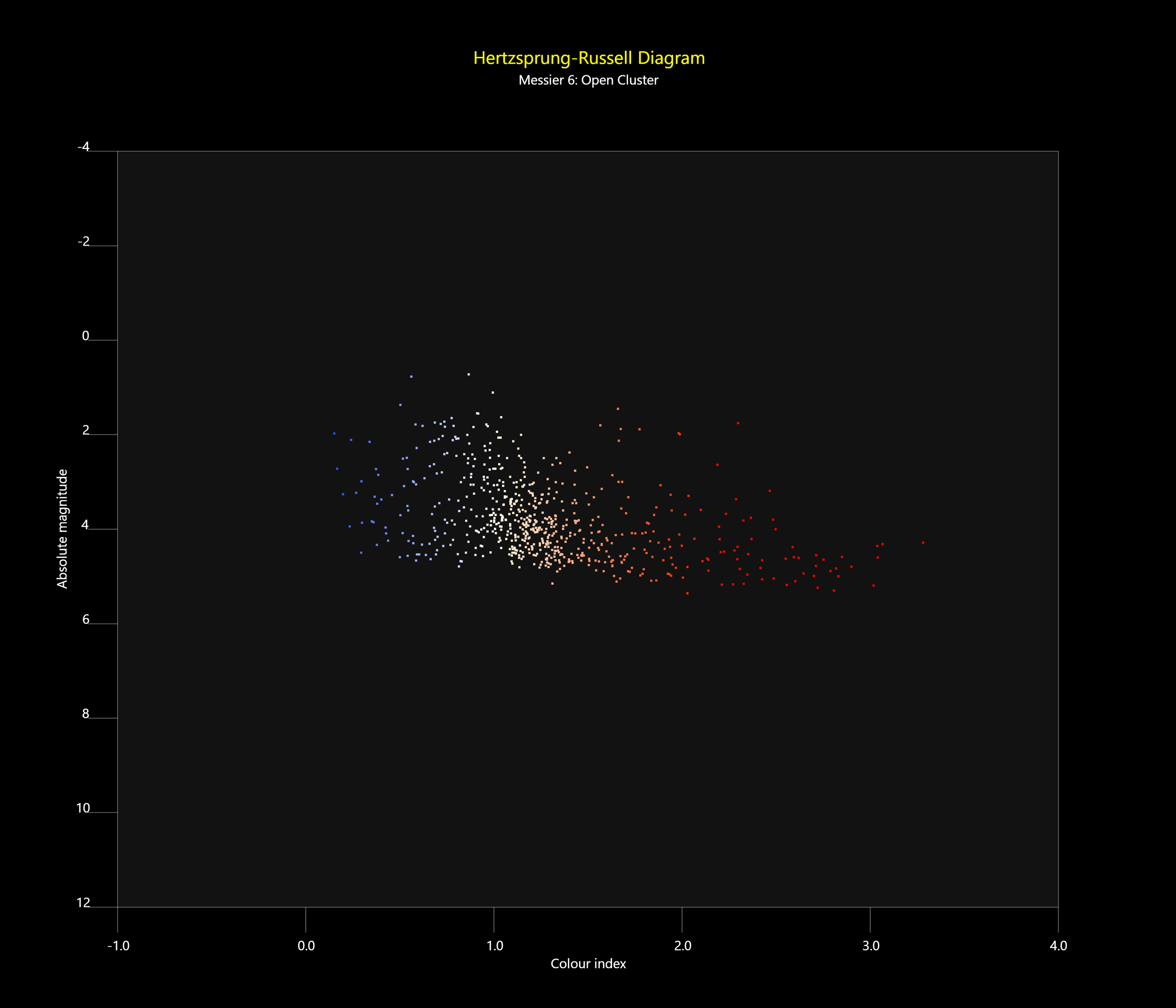
As we can see from the above graph, the most obvious feature is the dense band of stars stretching from a point on the top left to a point on the bottom right. This is known as the ‘main sequence’. These are the stars fusing hydrogen into helium in their cores. This is where a star will spend most of its life. One of the most useful things about an HR (Hertzsprung-Russell) diagram is that it can tell us the age of a star cluster. Astronomers will look for a point where stars begin leaving the main sequence; this is known as the ‘main-sequence turnoff’. The above diagram shows that there are plenty of blue stars, very few evolved stars, and only a small number of stars lying above the main sequence. Because of the number of blue stars, this suggests the open cluster is pretty young (about 100 million years old). A small number of evolved giants ar epresent, shwoing that only the most massive stars have begun to leave the main sequence.
Some of the stars don’t lie on a perfect thin line, this could be due to measurement uncertainties, inresolved binary stars, field stars being measured by mistake, or any interstella dust.
Equipment
Telescope: REDCAT 51
Mount: HEQ5-Pro
Camera: ZWO ASI585MM PRO
Filters: Antlia HA 3NM, R G B V-pro Series
Filter Wheel: ZWO EFW
Focuser: ZWO EAF
Computer: ZWO ASI AIR Pro
Guide Scope: ZWO 120MINI
Guide Camera: ZWO 120MM
Dew Heater: SV-BONY Dew Heater
Capture Details
Light Frames:
RED: 180 seconds x 20 frames
GREEN: 180 seconds x 20 frames
BLUE: 180 seconds x 21 frames
HA: 180 seconds x 10 frames
Total: 3.55 hours
Understanding the Diagram
Main Sequence Stars: These appear on the graph as a diagonal group from top left to the bottom right. Described as sun-like stars within this region of the diagram.
Giants and Super Giants: These stars appear on the top right. Given they are giants/supergiants, they are massive stars but are not very hot compared to other types of stars.
White Dwarfs: Hot, but very dim and very small stars.
