Messier 44 - Beehive Open Cluster
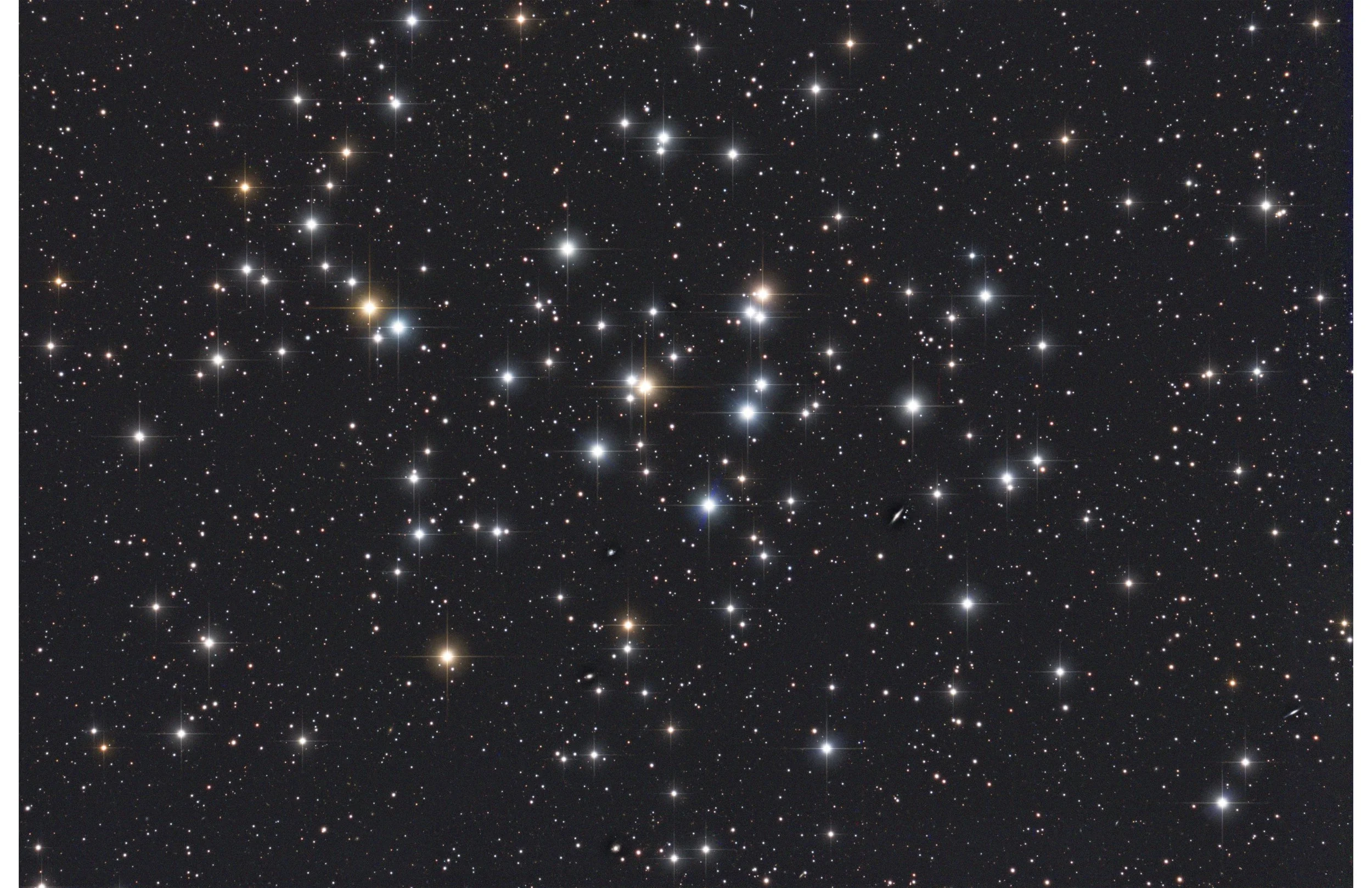
Messier 44 (M44), also known as the Beehive Open Cluster, was catalogued by Charles Messier in 1769, making it the 44th object in his catalogue. The name ‘Beehive Closter’ was given to this object due to its appearance through small telescopes. It is described as a cluster that looks like a swarm of bees! It is also catalogued as NGC 2632.
Open Cluster
An open cluster refers to a group of stars that have formed in the same region, from the same molecular cloud, loosely bound by gravity. Stars that have formed in molecular clouds are mostly of a similar age and made up of similar compositions. These groups of stars generally contain anywhere from a few dozen to a few thousand stars that can be spread over a distance of up to 30 light-years, though this is considered irregular. Open clusters, on a galactic scale, are short-lived occurrences due to gravitational interactions with other stars and tidal forces of the Milky Way. Generally speaking, open clusters last only for a few hundred million years. In the case of Messier 44, it is estimated to be about 600-700 million years old. Considered to be relatively old for an open cluster.
There are over 1,000 stars that are considered to be a part of this open cluster, though some are not bright enough to be observed. This cluster is roughly 12 light-years across and is estimated to be around 500-600 solar masses.
Location
Messier 44 is located in the constellation of Cancer. Messier 44 is considered to be very close to Earth, lying about 577 light-years. It covers an area of about three full moons in the night sky.
In the Southern Hemisphere, it is best observed in March.
Annotated Image
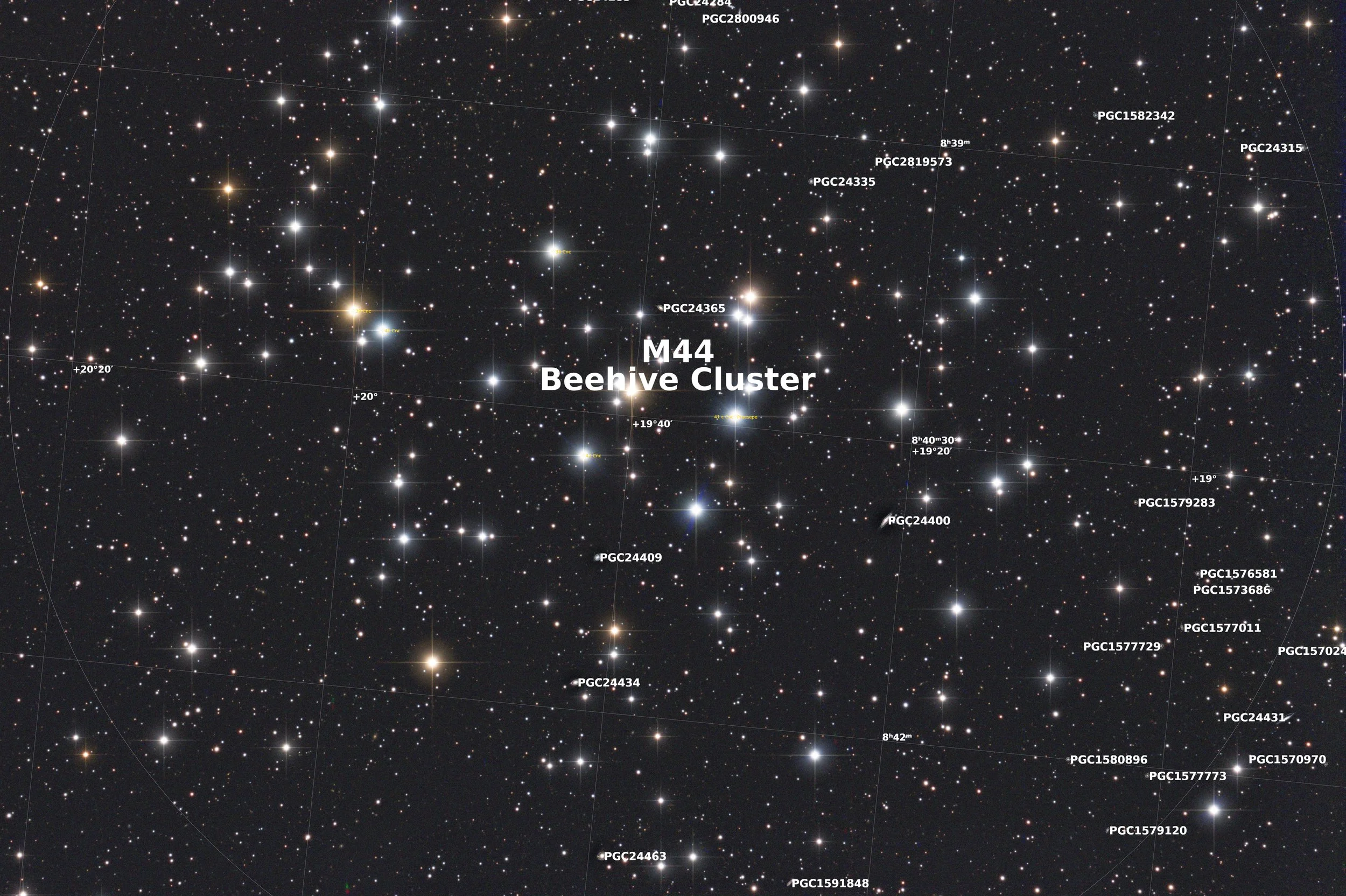
This image contains several background galaxies, all labelled as PGC and then a corresponding number. There are approximately 23 galaxies labelled in this image. PGC stands for Principal Galaxies Catalogue, a large catalogue of galaxies that was compiled in 1989.
Stars in Messier 44
Messier 44 is home to predominantly blue and white main-sequence stars, accompanied by red giants and white dwarfs.
Main-sequence stars are like our very own sun; they’re still fusing hydrogen in their cores. As for the red giants, these are brighter, more evolved stars that have left the main-sequence phase and have turned into red giants. Typically, they are cooler than our sun but more luminous. White dwarfs are stars that have completed their life cycle. They are what remains of the star, a hot, dense core. All that remains of a low-to-medium mass star has exhausted its fuel. There are also several binary or even triple systems, stars with one or more companions.
Lets Test the Science
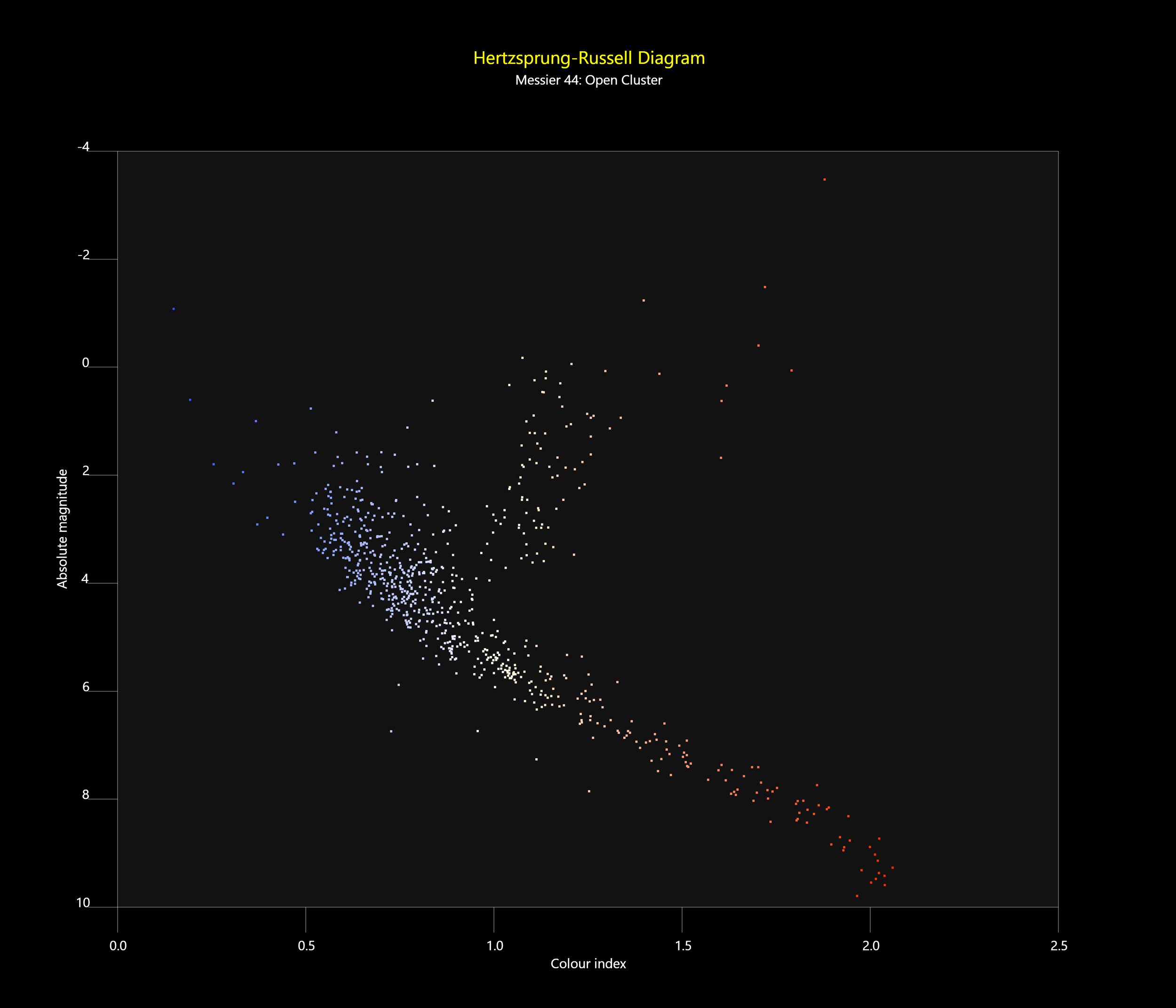
Understanding the Diagram
Main Sequence Stars: These appear on the graph as a diagonal group from top left to the bottom right. Described as sun-like stars within this region of the diagram.
Giants and Super Giants: These stars appear on the top right. Given they are giants/supergiants, they are massive stars but are not very hot compared to other types of stars.
White Dwarfs: Hot, but very dim and very small stars.
As we can see from the above graph, there is a very well-formed section of main-sequence stars, which is expected. Also, noticing that there are some stars which are leaving the main-sequence. This ‘bend’ can help determine the age of clusters as stars begin to exhaust their core hydrogen. You can almost think of this graph as a running race, all the stars are starting at the same time, faster runners (massive stars) finish first and move off the main sequence toward the upper-right (red giant region). Slower runners (smaller stars) are still running. The main turn-off point appears to occur around yellow-white stars, indicating stars slightly more massive than the Sun are now evolving off the main sequence, stars that are more massive than our Sun and therefore will die sooner. Despite bigger stars having more fuel, they have much shorter lives than those of low-mass stars. This is because stars with higher mass have much higher core pressure and temperature, which make nuclear fusion run more rapidly and thus burn through their fuel much faster.
Equipment
Telescope: ASKAR 120APO
Mount: HEQ5-Pro
Camera: ZWO ASI2600MM PRO
Filters: Antlia L, R G B V-pro Series
Filter Wheel: ZWO EFW
Focuser: ZWO EAF
Computer: ZWO ASI AIR Pro
Guide Scope: ZWO 120MINI
Guide Camera: ZWO 120MM
Dew Heater: SV-BONY Dew Heater
Capture Details
Light Frames:
RED: 180 seconds x 20 frames
GREEN: 180 seconds x 20 frames
BLUE: 180 seconds x 20 frames
Total: 3 hours
