Messier 78 - Reflection Nebula
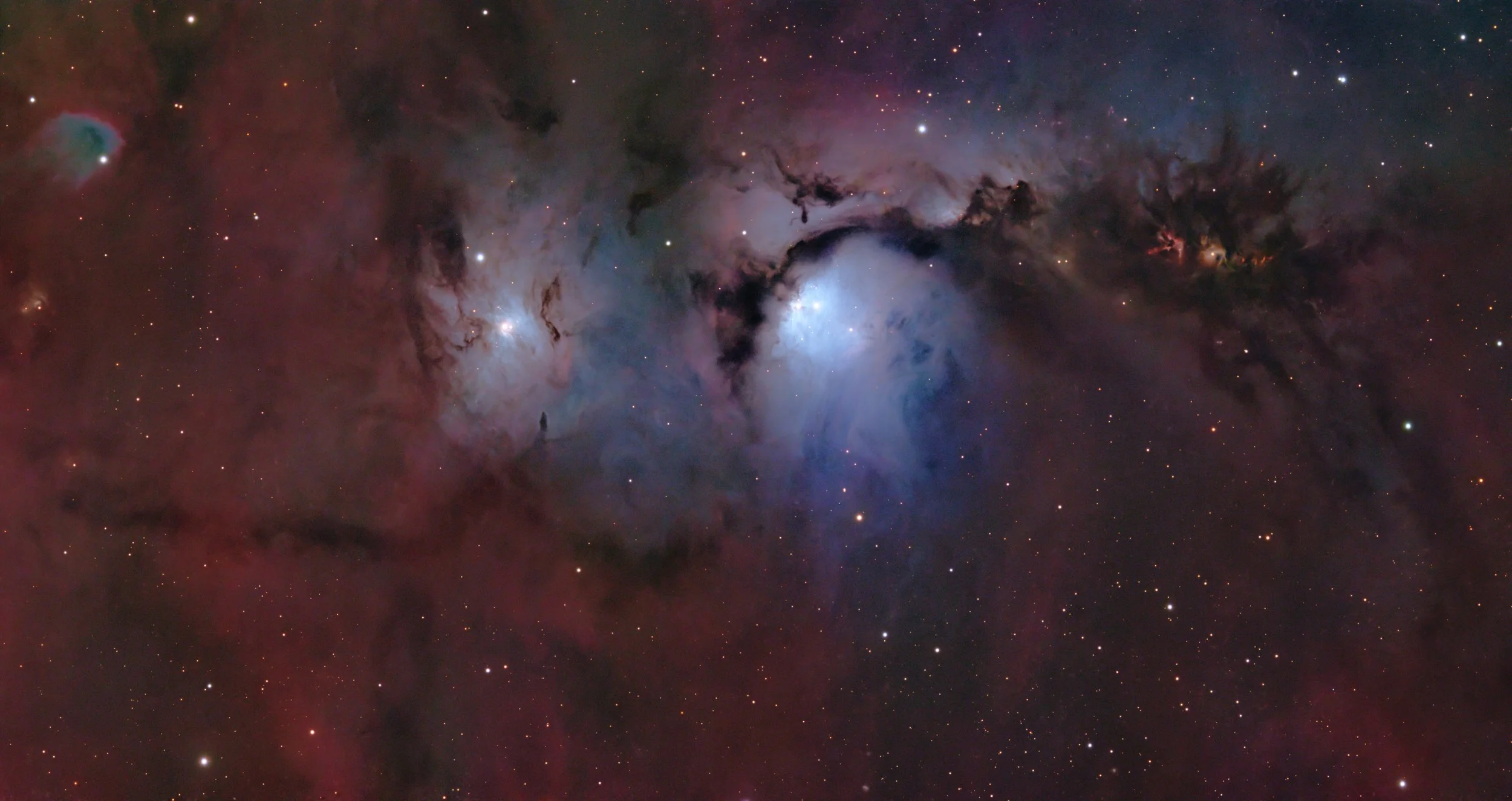
Messier 78 (M78), also known as the Casper the Friendly Ghost Nebula, was discovered by Pierre Mechain in early 1780 and later catalogued by Charles Messier in December 1780. It is also categorised in the NGC catalogue as NGC 2068. NGC 2064, NGC 2067, and NGC2071. Messier 78 is part of the Orion Molecular Cloud Complex, which is one of the closest large star-forming regions to Earth.
Reflection Nebula
A reflection nebula is a cloud of dust in space that is visible due to light reflecting off the nearby stars. These nebula types don’t produce their own light. What makes these different from emission nebulae is that there is insufficient energy from nearby stars to ionise the gas of the nebula. Reflection nebulae are very commonly found to be blue, and this is due to a process called ‘scattering’, very similar to Rayleigh scattering. While the nearby stars may be blue, the dust is what changes how the light is scattered, and blue light has a stronger presence due to its shorter wavelengths compared to red light. Many reflection nebulae are likely illuminated by hot, young blue stars that emit a lot of blue light, which would be what enhances this effect.
Location
M78 is located in the region of the Orion constellation, a well-known constellation among astronomers. The Orion constellation is known for being home to bright nebulae such as the Orion Nebula, the Horse Head, and the Flame Nebula. Orion is also home to a massive red supergiant star on the shoulder of Orion. This star is famous for its sudden dimming, which was likely caused by the star ejecting a large cloud of dust that blocked some of its light from reaching Earth. It is expected to go supernova within the next 100,000 years.
Messier 78 is about 1,300-1,400 light-years away from Earth, which means it took light from this object about 1,400 years to reach us here on Earth. In other words, this is an image that shows what the object looked like 1,400 years ago. That’s why telescopes are sometimes referred to as time machines. The object is about 5 light-years across.
Orion's belt is made up of three stars, Mintaka, Alnilam, and Alitak. Just below Alnitak and to the right, near Barnard’s Loop, is where Messier 78 is located.
Annotated Image
Further Observations
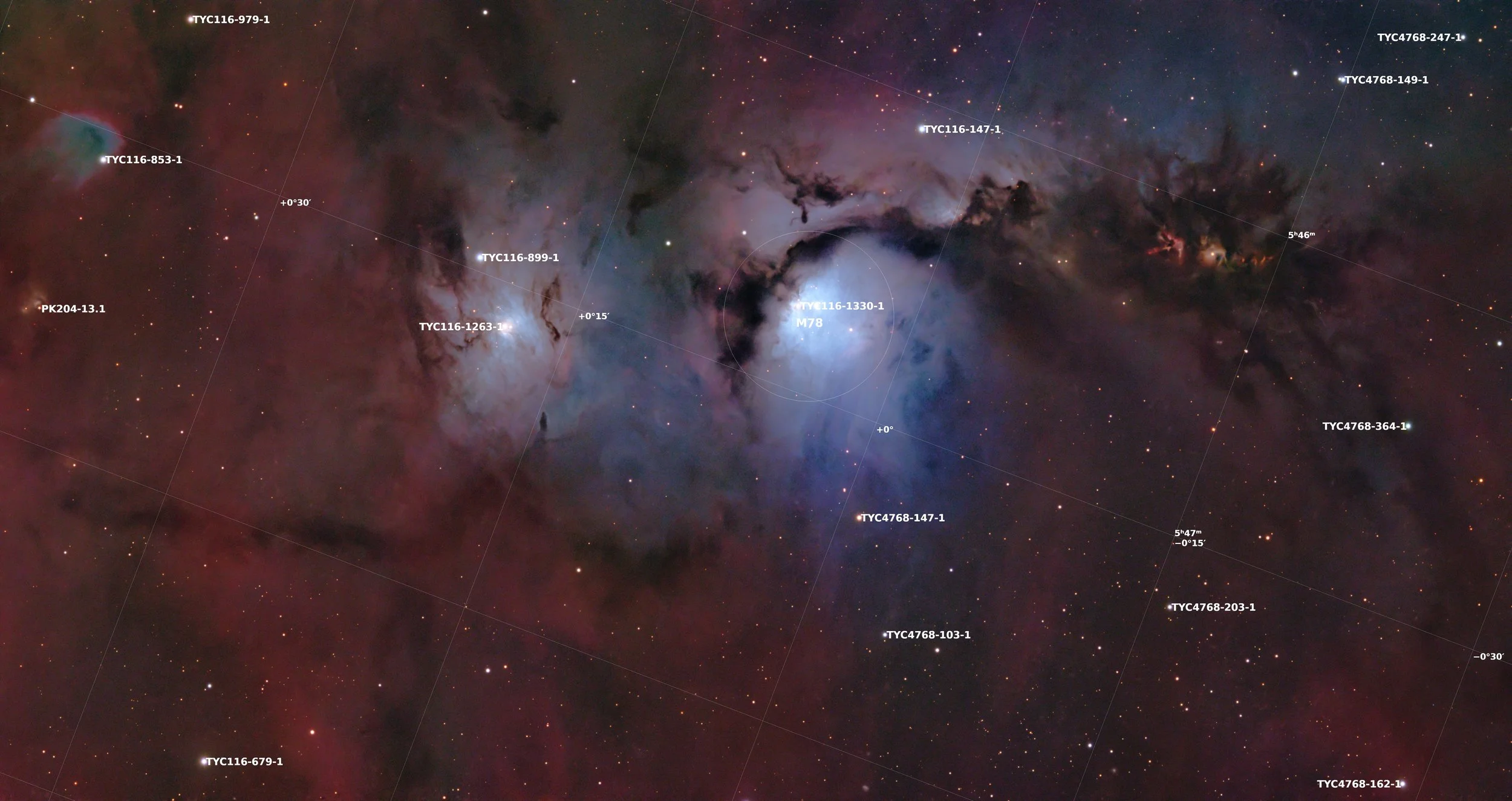
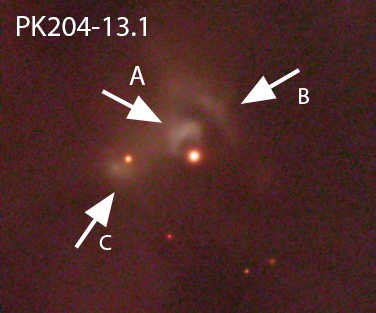
After running my image through Pixinsights AnnotateImage script, it has identified a planetary nebula (PN). PK204-13.3 has not been studied in great detail; in fact, very little is known. A PN forms when a medium-sized star is reaching the end of its life, the star has exhausted all its hydrogen and helium, and begins to blow off its outer layers into space. This creates a glowing shell of gas around the dying star. What’s left over is the core that becomes a white dwarf, which emits UV light that illuminates expelled gas.
Purely based on observations from the main image, it appears the PN may have two distinct shells or layers (marked as A and B). Many PN with complex morphology are thought to have multiple layers or shells. These can form when the central star sheds its outer layers at different points in its final stages of life. Each layer could represent a different stage in the loss of mass from the star.
There also appears to be some mass interacting with the nearby star (marked as C). It may be a binary star system with gravitational forces from the two stars leading to a distortion in the PN’s shape. Surrounding stars that may have complex interactions with one another could have a significant role in shaping the PN structure.
Equipment
Telescope: SkyWatcher Evostar ED80
Mount: HEQ5-Pro (belt modified)
Camera: ZWO ASI585MM PRO
Filters: Antlia L, R G B V-pro Series
Filter Wheel: ZWO EFW
Focuser: ZWO EAF
Computer: ZWO ASI AIR Pro
Guide Scope: ZWO 120MINI
Guide Camera: ZWO 120MM
Dew Heater: SV-BONY Dew Heater
Battery: Powertech 1,000WH
Capture Details
Light Frames:
RED: 180 seconds x 93 frames
GREEN: 180 seconds x 103 frames
BLUE: 180 seconds x 98 frames
LUM: 180 seconds x 226 frames
Total: 26 hours
