Messier 83 - Southern Pinwheel Spiral Galaxy
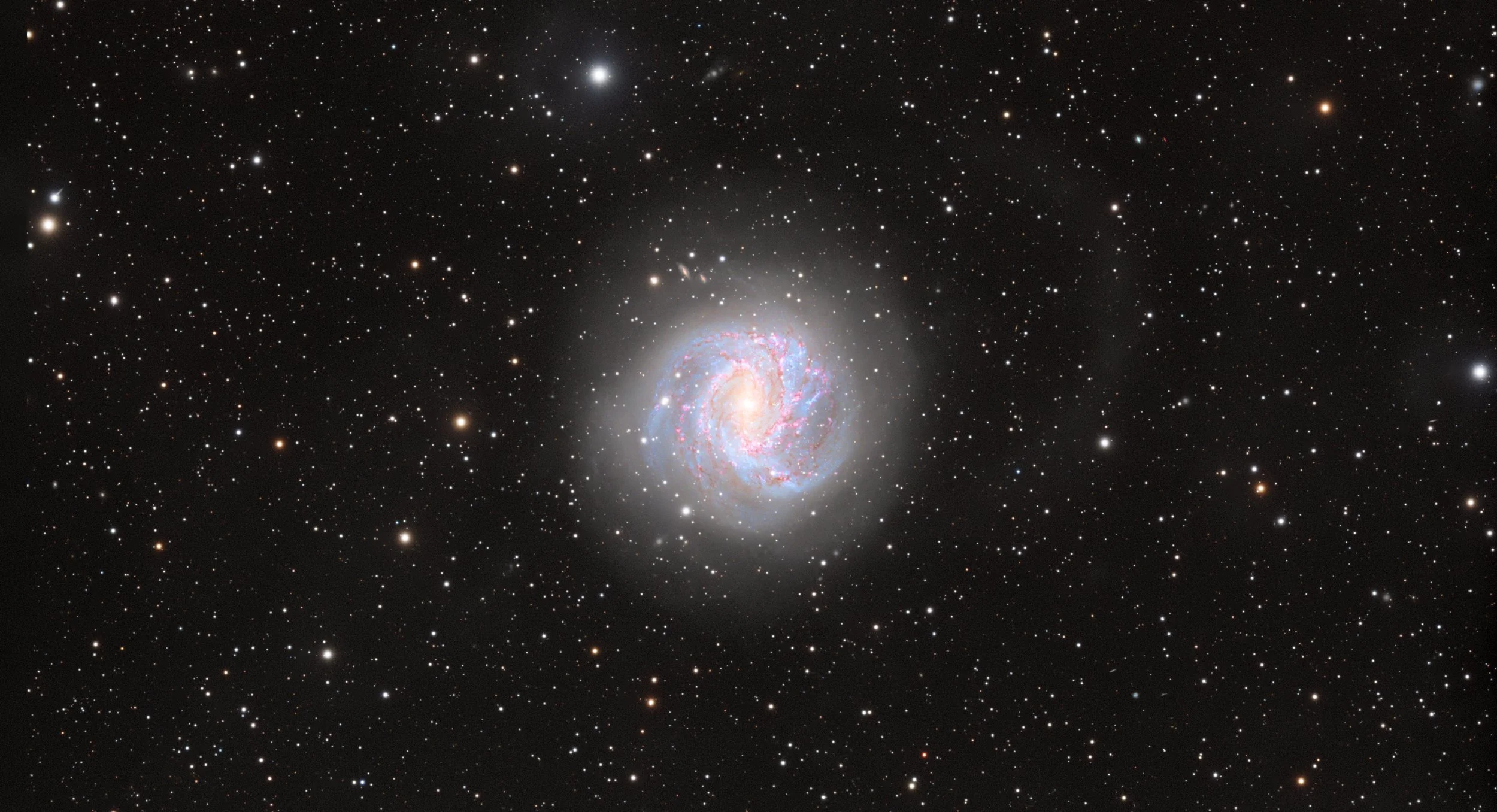
Messier 83 (M83), also known as the Southern Pinwheel Galaxy, was discovered by Nicolas Louis de Lacaille in 1752 and was later added to the Messier Catalogue by Charles Messier in 1781. It is also catalogued as NGC 5236 in the New General Catalogue. Messier 83 is one of the brightest and most prominent nearby galaxies. It is also a member of the Centaurus Group which is a collection of galaxies that includes the well-known galaxy Centaurus A.
Spiral Galaxy
Spiral galaxies are one of the most beautiful and well-studied structures. These galaxy types, which include galaxies like our own Milky Way, were classified as part of the Hubble sequence by Edwin Hubble. At the cores of these galaxy types lies a dense bulge composed mostly of older stars, often surrounding a supermassive black hole. At the same time, the surrounding disk contains gas, dust and younger stellar populations. The most defining feature - being the spiral arms - are not a fixed structure but rather regions of higher density known as density waves, where gas is compressed as it orbits the galaxy, triggering intense star formation. This is why spiral arms appear bright and blue—dotted with glowing hydrogen regions and clusters of young stars. In the above image of Messier 83, hydrogen has been imaged separately to try to bring a pop of red.
Spiral galaxies are dynamic and constantly evolving systems. They form from the collapse of rotating clouds of gas and continue to change over billions of years through internal processes and external interactions. Gravitational encounters with other galaxies can distort their structure, producing tidal tails, warped disks, and faint outer features like those sometimes observed in deep images of galaxies such as Messier 83. These galaxies are also sites of ongoing stellar birth and death, with massive stars forming in the arms and eventually ending their lives as supernovae, enriching the interstellar medium with heavier elements. Because of these processes, spiral galaxies serve as important laboratories for understanding star formation, galactic dynamics, and the role of dark matter in the universe, making them central to modern astrophysics.
Location
Messier 83 is located in the constellation Hydra, making it a brilliant target for observers in the Southern Hemisphere. It is approximately 14-15 million light-years away from Earth, which is a relatively close cosmic neighbour on the galactic scale. The closeness is one of the reasons it appears so bright and well-resolved compared to other galaxies.
This galaxy is fairly large, measuring around 50,000-60,000 light-years across. When comparing to our own home, the Milky Way, which is roughly 100,000-120,000 light-years in diameter, Messier 83 is about half the size. Despite being smaller, it is often more actively forming stars than the Milky Way, giving it a brighter and more dynamic appearance, especially in its spiral arms.
It is thought that Messier 83 was formed about 10-13 billion years ago.
Annotated Image
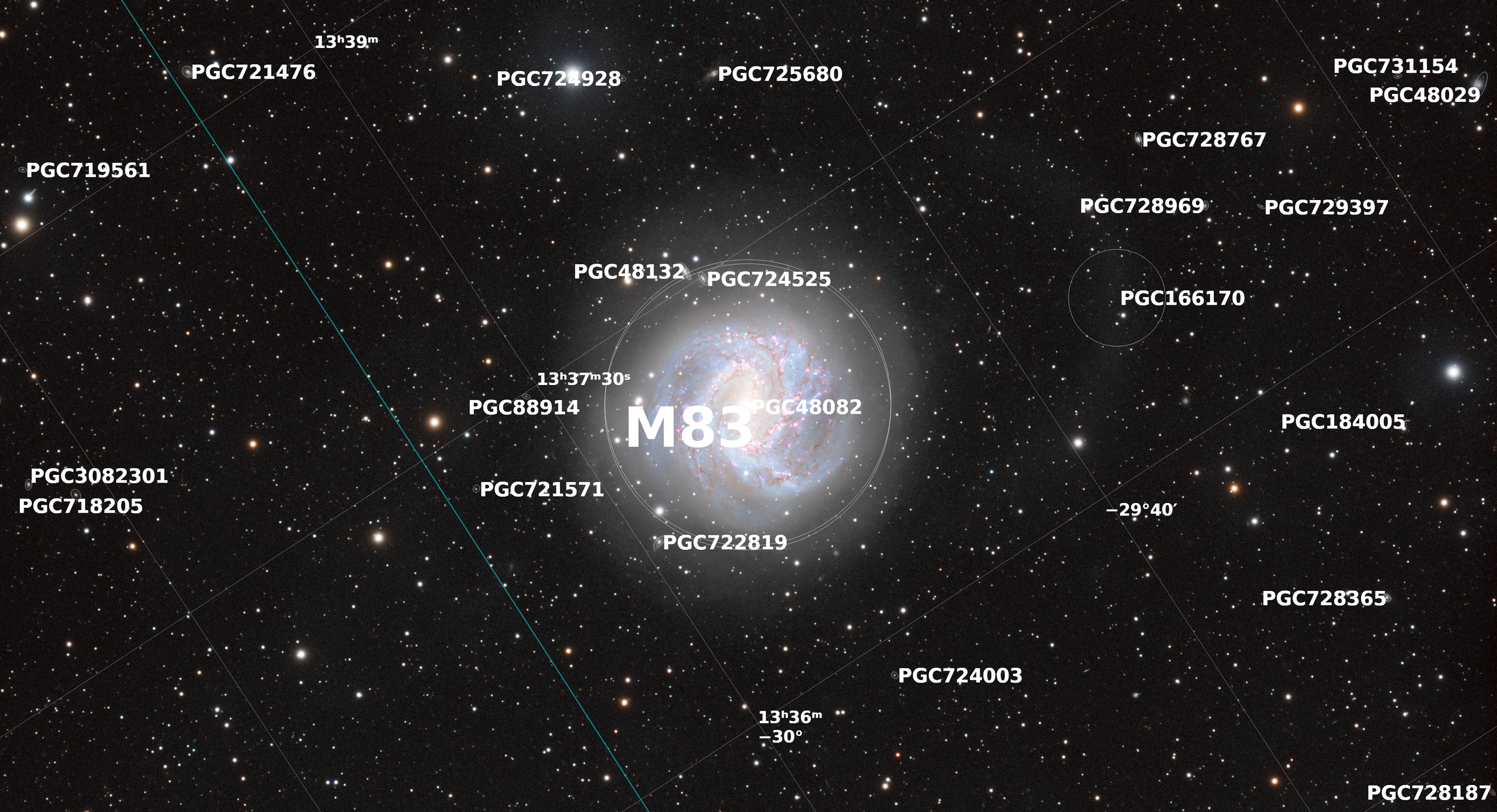
This image contains several background galaxies, all labelled as PGC and then a corresponding number. There are approximately 21 galaxies labelled in this image. PGC stands for Principal Galaxies Catalogue, a large catalogue of galaxies that was compiled in 1989.
Equipment
Telescope: Sky-Watcher ED80
Mount: HEQ5-Pro Belt modified
Camera: ZWO ASI585MM PRO
Filters: Antlia L, R G B V-pro Series
Filter Wheel: ZWO EFW
Focuser: ZWO EAF
Computer: ZWO ASI AIR Pro
Guide Scope: ZWO 120MINI
Guide Camera: ZWO 120MM
Dew Heater: SV-BONY Dew Heater
Capture Details
Frames:
RED: 180 seconds x 107 frames
GREEN: 180 seconds x 76 frames
BLUE: 180 × 95 frames
LUMINANCE: 180 seconds x 80 frames
Hydrogen-Alpha: 180 seconds x 157 frames
Total: 25.75 hours
