Messier 66 - Intermediate Spiral Galaxy
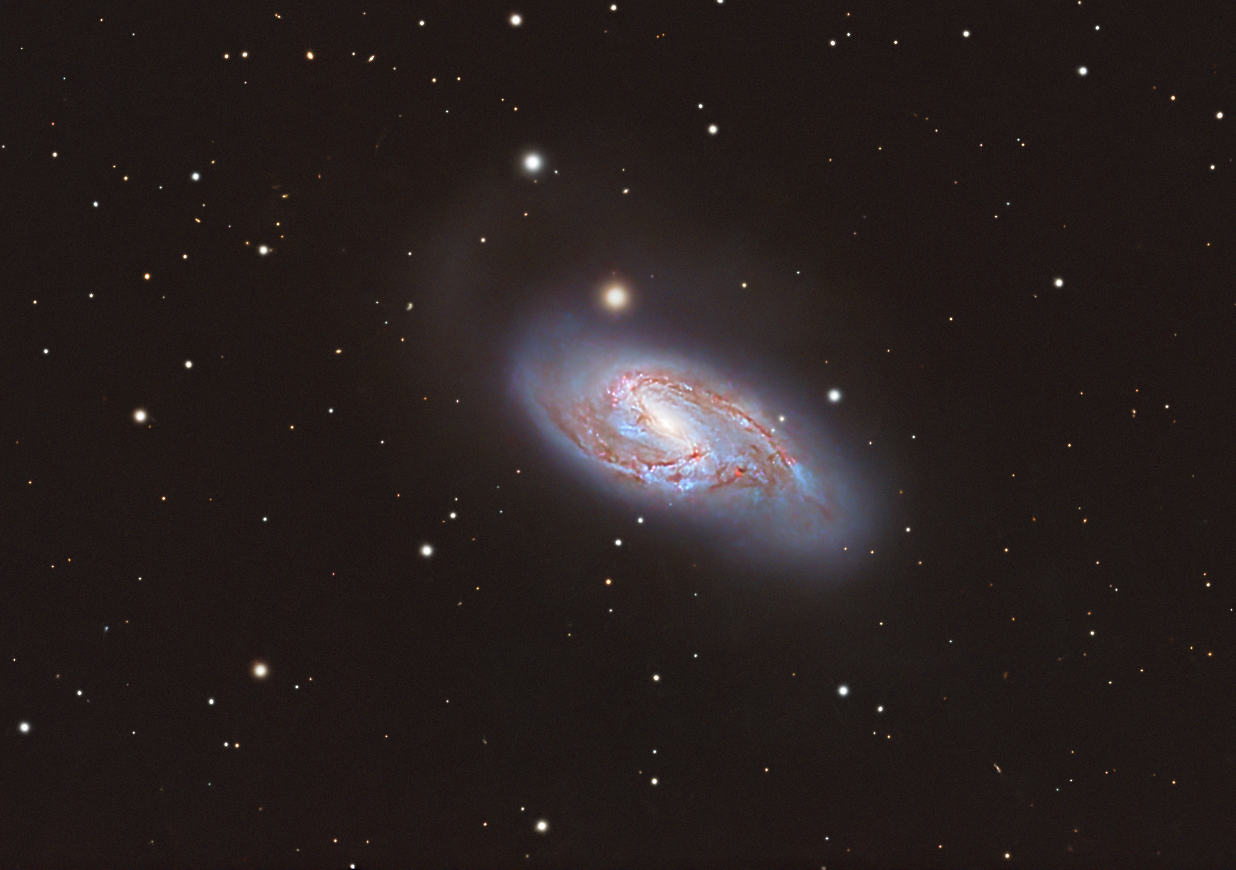
Messier 66 (M66) was discovered by Charles Messier on the 1st of March in 1780. It was originally described by Messier as a “nebula without stars” before adding that it is “very long and very faint”. It is also listed in the New General Catalogue as NGC 3627.
Intermediate Spiral Galaxy
The intermediate spiral galaxy is a type of galaxy that is between a normal spiral galaxy (SA) and a barred spiral galaxy (SB) in the classifications by Hubble/de Vacucouleurs.
Messier 66 is also known for its dark dust lanes and bright starburst regions along the spiral arms, where a large amount of star formation. Messier 66 is believed to be moving away from Earth at a rate of about 700 kilometres per second.
Location
Messier 66 is located in the Leo constellation and is about 35 million light-years away from Earth with an apparent magnitude of 8.9.
In the Southern Hemisphere, this galaxy is best observed in April.
Gravitational Forces in the Leo Triplet
Messier 66 is part of a small group of galaxies called The Leo Triplet. This group contains Messier 66, Messier 65 and NGC 3628. These three galaxies are currently interacting with one another, and their gravitational pull is having an effect on each of the galaxies and impacting them in different ways. This gravitational impact has been significant for the structure of Messier 66.
It is believed that roughly a billion years ago, NGC 3628 had an encounter with Messier 66, possibly passing by one another, which has caused Messier 66 to bulge slightly. This is why Messier 66 is often described as being a very ‘messy’ galaxy, with its asymmetric spiral arms and what appears to be a displaced core.
